



National Social Work Program
National Social Work Program
Social workers are an integral part of the Veterans Health Administration (VHA). Social workers' primary focus is to assist Veterans, their families and caregivers in resolving social determinants of health challenges to health and well-being using a person in environment perspective. Social workers are Licensed Independent Practitioners and are key members of interdisciplinary teams across programs. Social work services are an essential component in the continuum of clinical services provided to Veterans in VHA facilities. Social workers assist Veterans by assessing and providing support and assistance in various areas of care coordination. They connect Veterans with resources, services and programs to meet their current needs and address issues related to access to care, psychological status, economics, functional status, housing and social support.
The National Social Work Program provides policy development for the professional practice of social work for VA’s social work programs nationwide. VA is the largest employer of social workers in the Nation with over 17,300 Master’s prepared social workers. VA trains more social work graduate students than any other single agency. The social work allied health trainee program in collaboration with the Office of Academic Affiliations offers approximately 1,500 stipends per year and helps meet succession planning for social work.
You will find social workers in all program areas in VA facilities who are ready to help you with most any need. If you have questions or problems, the social worker will be able to help you or can refer you to the right person for help.
Social Workers provide a variety of clinical interventions and programming within the VA System and the community, these include but are not limited to the following:
- Information linkage and referral
- Discharge planning
- Outreach to homeless Veterans
- Counseling and psychotherapy
- Case management
- Financial Assistance referral
- Housing and community living options
- Assessment treatment of substance abuse problems
- Advanced Care Planning, mental health preferences and long term term planning
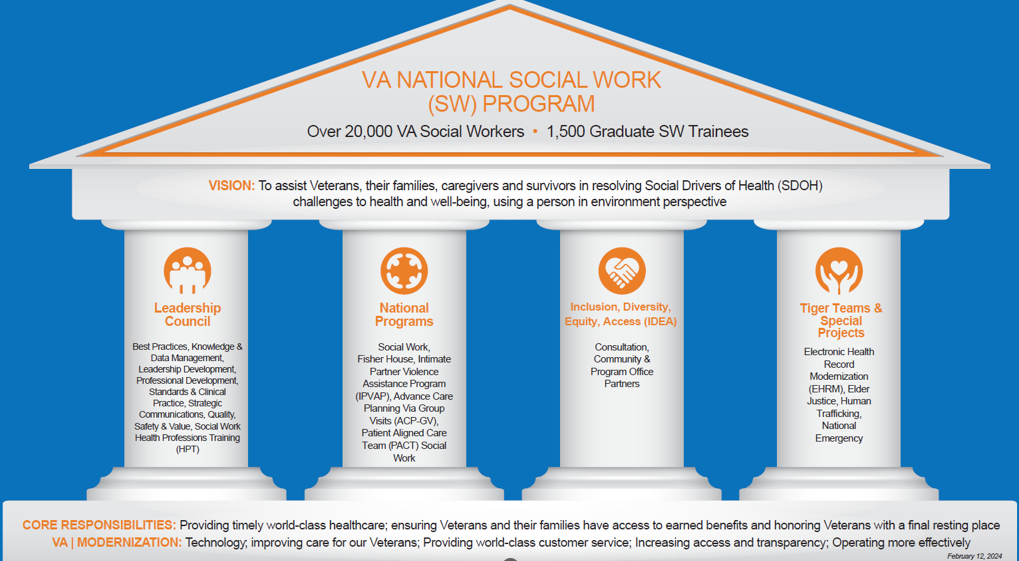
Check out these links for more information about VA Program Offices:
- Caregiver Support Program
- Community Based Outpatient Clinic (CBOC)
- Compensated Work Therapy (CWT)
- Compensation & Pension (C&P)
- Dialysis
- Employee Assistance Program (EAP)
- Fisher House
- Geriatrics and Extended Care Programs
- Geriatric, Research, Education, Clinical Center (GRECC)
- Homeless Programs
- Health Promotion Disease Prevention (HPDP)
- Home Based Primary Care (HBPC)
- Hospice and Palliative Care (HPC)
- Intimate Partner Violence Assistance Program (IPVAP)
- LGBTQ+ Program
- Mental Health
- Mental Illness Research, Education and Clinical Centers (MIRECC)
- Military Sexual Trauma (MST)
- MOVE! Weight management Program for Veterans (MOVE!)
- Patient Aligned Care teams (PACT) - Primary Care
- Polytrauma/TBI System of Care
- Post 9/11 Transition and Case Management
- Rehabilitation and Prosthetic Services
- Spinal Cord Injury/Disorders (SCI/D) System of Care
- Suicide Prevention
- VA Liaisons for Healthcare